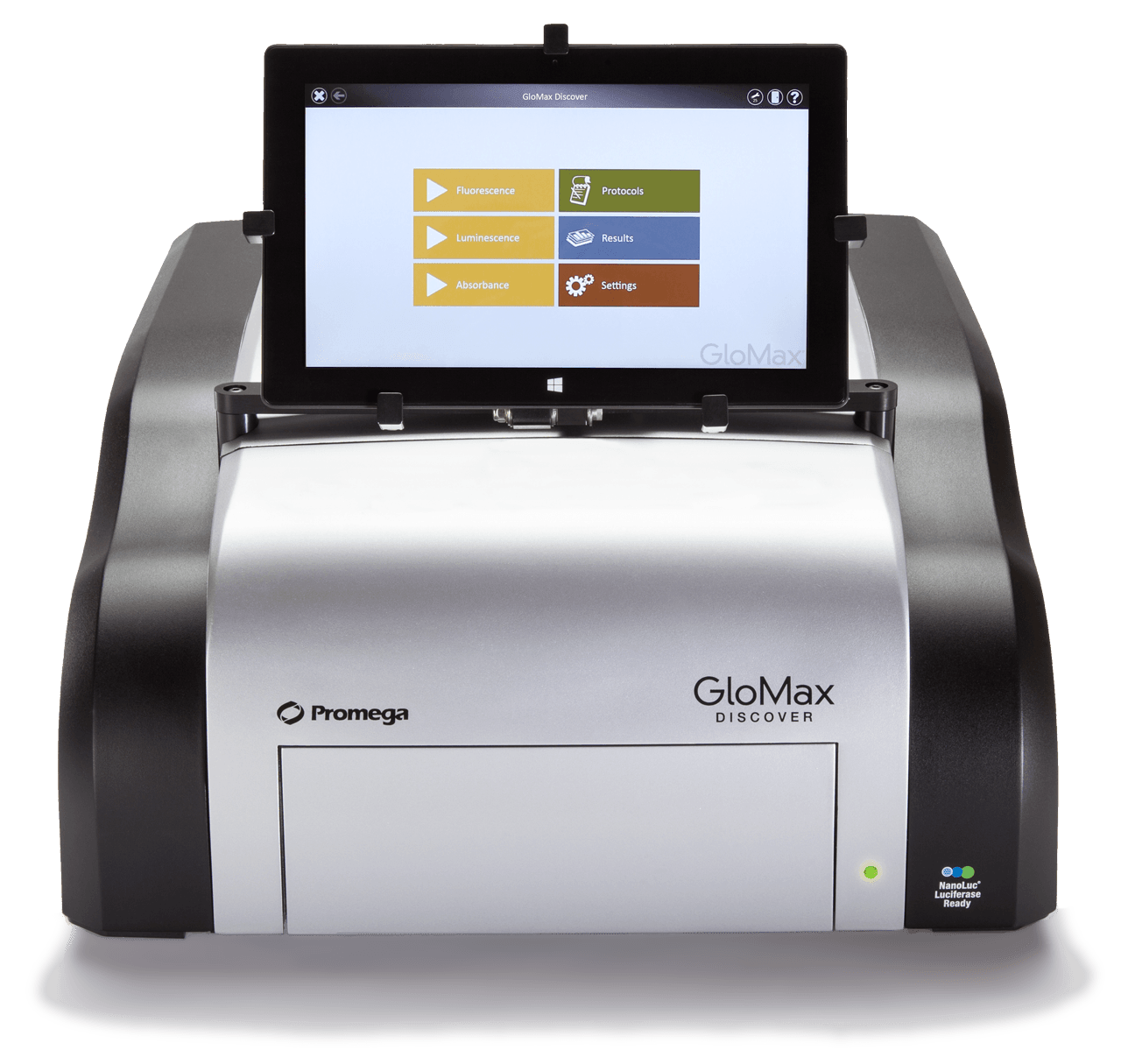
GloMax® Discover Microplate Reader
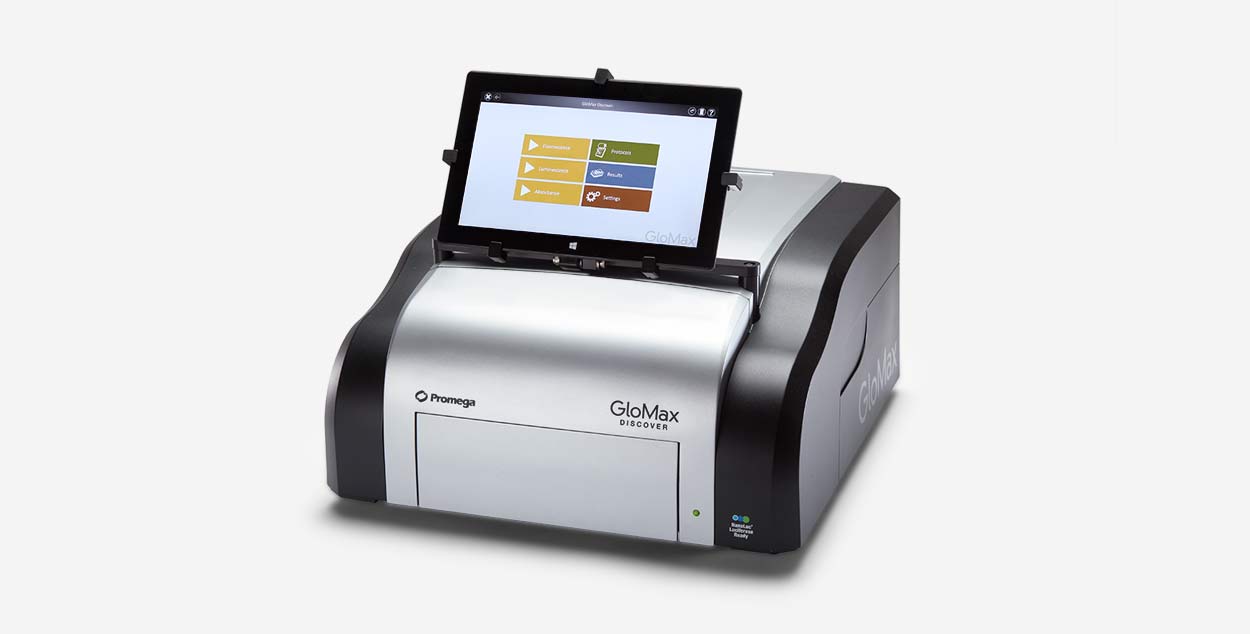
Multimode Microplate Reader with Advanced Detection Capabilities
- Luminescence, fluorescence, UV-visible absorbance, BRET and FRET detection, on a 384-well microplate reader
- Built to run Promega NanoBRET® and luciferase reporter assays out of the box, with preloaded protocols
- Optional dual-reagent injectors support flash luciferase assays
- Can be used as a standalone plate reader or integrated into high-throughput automated workflows
- Integrated data analysis software makes results easy to interpret
Catalog Number:
Size
Catalog Number: GM3000
Easy-to-Use Plate Reader
GloMax® Discover is a ready-to-use multimode plate reader developed with Promega reagent chemistries to provide a simple means of detecting luminescence, fluorescence and absorbance.
- High-performance luminescence, fluorescence, UV-Visible absorbance, BRET and FRET, two-color filtered luminescence and kinetic measurement capabilities
- Can be used as a standalone plate reader or integrated into high-throughput automated workflows
- Integrated data analysis software makes results easy to interpret

What Is the Best Multimode Microplate Reader for Luminescence and NanoBRET® Assays?
The best fit depends on throughput and workflow. GloMax® Discover suits labs running NanoBRET®, BRET and luciferase reporter assays, with reagent-matched protocols, optional injectors and built-in BRET/FRET capabilities—without the added cost of full HTS-class monochromator systems. The instrument features a detection limit of 3 x 10–21 moles of luciferase with a linear dynamic range of 9 logs, making it ideal for detection of both high and low signals on the same plate.
Does GloMax® Discover Support Dual-Emission BRET Detection?
Yes. GloMax® Discover measures BRET and FRET using two-color filtered luminescence detection with a built-in filter paddle and a single high-sensitivity PMT. Donor and acceptor signals are read sequentially rather than simultaneously—a simpler, lower-cost approach well suited to routine BRET assays with stable signal kinetics.
Preloaded Protocols for Faster, Easier Data Analysis
GloMax® Instruments Come with Dozens of Preloaded Protocols




GloMax® Application Notes
No need to reinvent the wheel—we’ve already used GloMax® instruments for everything from cell viability, toxicity and metabolism, kinase and cell signaling, reporter gene assays, nucleic acid quantitation for NGS sequencing, PROTACs and protein degradation, bioassays, BRET, ELISAs and even water quality testing. Search our Application Notes collection for examples using GloMax® instruments with a wide range of bioluminescence- and fluorescence-based assays.
Streamline Your Workflow with Automation
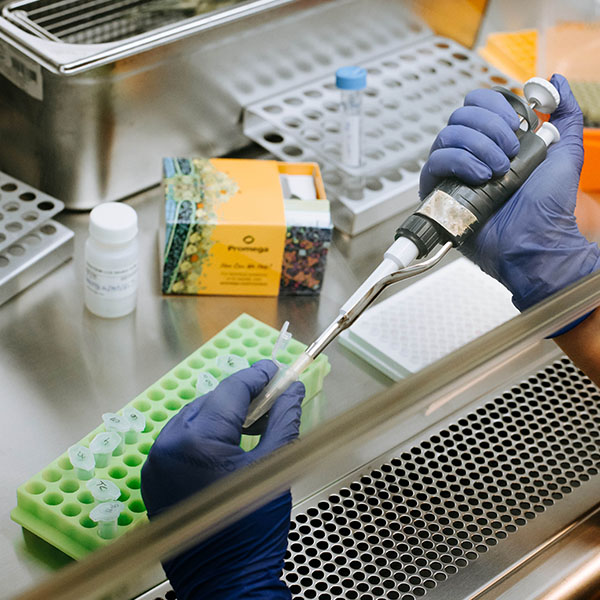
GloMax® Discover integrates with many commercially available automated systems, including liquid handers, plate stackers and robotic arms to enable seamless workflows for high-throughput assay quantitation and screening.
Our built-in and compliant SiLA2 communication driver makes integration easy.

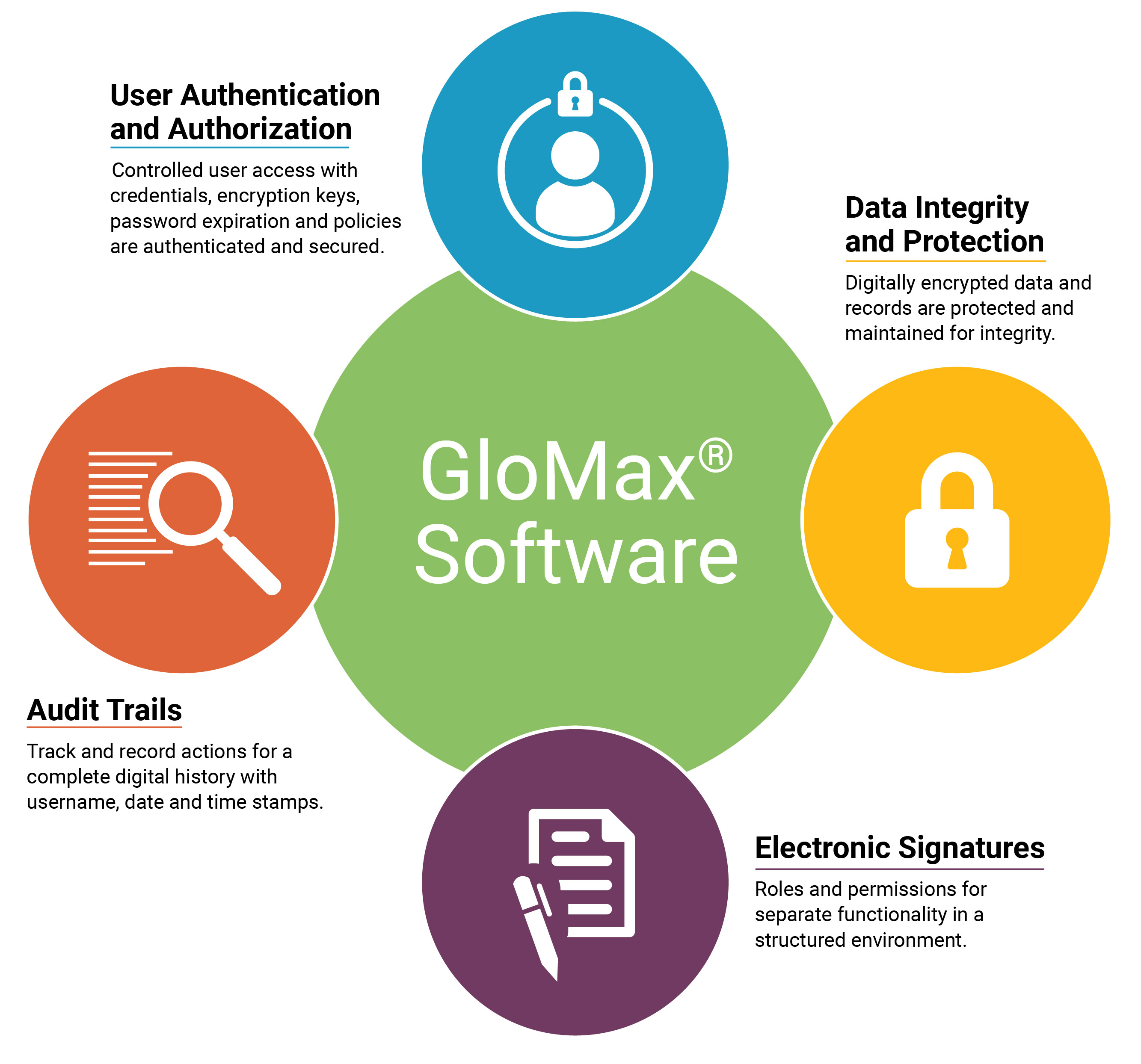
Microplate Reader Compliance for Your GxP Workflow
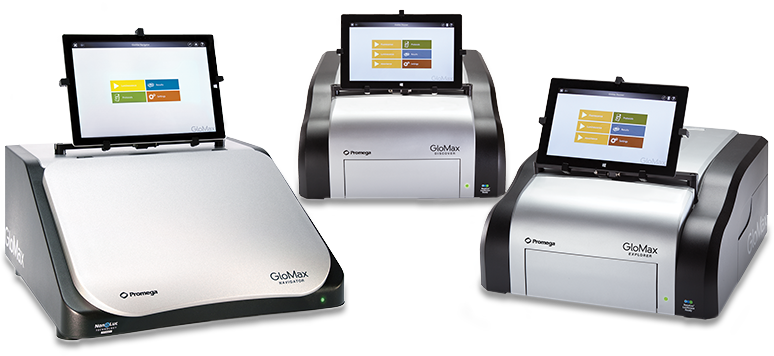
Not sure if GloMax® Discover is the right plate reader for your lab?
Find the instrument that's right for your needs. Compare Plate Readers
Service and Support
One Call Supports It All
Promega supplies both the reagents and the instrument, so one call to Promega answers any questions you may have about assay chemistries or instrument performance.
Ensure Minimal Instrument Downtime
- Field Support and Loaner Programs
- Service Packages
- IQ and OQ Packages
Warranty and Service Agreements
- Backed by a one-year warranty.
- Additional warranty and service agreements are available.
- For more information contact Promega Technical Services

Available Separately
| Product | Catalog # |
|---|---|
| Luminometer Light Plate | E6531 |
| Bar Code Reader | AS3200 |
| USB Ethernet Adapter | AS8403 |
| GloMax® Discover Empty Luminescence Filter Paddle | GM3011 |
| GloMax® Discover Empty Fluorescence Filter Paddle | GM3012 |
| GloMax® Discover Luminescence Filter Paddle | GM1090 |
| GloMax® Discover Fluorescence Filter Paddle | GM1100 |
| GloMax® Discover 96 Half-Position Aperture Assembly | GM1050 |
| GloMax® Discover 96-Position Aperture Assembly | GM3040 |
| GloMax® Discover 384-Position Aperture Assembly | GM3041 |
| GloMax® Discover Aperture Plate | GM3042 |
| GloMax® Dual Injectors with Pump | GM3031 |
| Inner and Outer Injector Tubing, Natural | GM3014 |
| GloMax® Explorer Absorbance Module Upgrade | GM3520 |
| GloMax® Discover Sales Rental | E5301 |
| GloMax® Discover or Explorer Installation Qualification | SA1104 |
| GloMax® Discover or Explorer Operational Qualification | SA1105 |
| GloMax® Discover or Explorer Installation and Operational Qualification | SA1106 |
| GloMax® Discover Standard Service Agreement | SA4000 |
| GloMax® Discover or Explorer Preventive Maintenance | SA4030 |
| GloMax® Discover Premier Service Agreement | SA4002 |
| GloMax® Discover Premier Warranty Upgrade | SA4001 |
Protocols
Frequently Asked Questions
What is the best multimode microplate reader for luminescence and NanoBRET® assays?
The best fit depends on throughput and workflow. GloMax® Discover suits labs running NanoBRET®, BRET and luciferase reporter assays in 6- to 384-well formats, with reagent-matched protocols, optional injectors and built-in BRET/FRET filtered detection—without the added cost of full HTS-class monochromator systems.
Does GloMax® Discover support dual-emission BRET detection?
Yes. GloMax® Discover measures BRET and FRET using two-color filtered luminescence detection with a built-in filter paddle and a single high-sensitivity PMT. Donor and acceptor signals are read sequentially rather than simultaneously—a simpler, lower-cost approach well suited to routine BRET assays with stable signal kinetics.
Can a multimode reader handle NanoBRET® assays?
Yes. Any multimode reader with luminescence detection in the ~450–600nm range and dual-color optics, whether filtered or simultaneous dual-PMT, can run NanoBRET® assays. GloMax® Discover is validated with Promega NanoBRET® target engagement and protein-protein interaction assays using its built-in BRET/FRET filtered luminescence detection.
Do BRET assays need dual-emission detection?
Yes. BRET assays measure two wavelengths—the luciferase donor emission and the acceptor fluorophore emission—so the reader needs dual-wavelength capability, either sequential (filter-based, as in GloMax® Discover) or simultaneous (dual-PMT systems). Simultaneous detection reads faster but isn’t required for most standard BRET assays with stable kinetics.
Do you need reagent injectors for flash luminescence assays?
In most cases, yes. Flash-type luciferase assays, including Dual-Luciferase® assays, peak within seconds of substrate addition, so onboard injectors that dispense reagent immediately before each read reduce timing variability between wells. GloMax® Discover offers an optional dual-injector system (5–200μl dispense range) for this purpose.
What plate formats matter for high-throughput screening: 384, 1536, or 3456 wells?
Choice depends on throughput needs. 384-well plates are standard for routine screening and most cell biology labs; 1536- and 3456-well plates support ultra-high-throughput drug discovery, lowering reagent cost per well. GloMax® Discover supports 6- to 384-well plates; labs scaling to 1536-well campaigns should evaluate HTS-class readers.
Which features matter most for live-cell kinetic luminescence assays?
Key features include stable heating, orbital or linear shaking, fast kinetic read intervals and injector-based reagent addition. GloMax® Discover provides heating to 45°C, shaking from 100–500 cycles/minute and kinetic read modes, but has no CO2/O2 environmental control—extended, multi-hour live-cell incubation assays may need a dedicated incubator or an HTS platform with built-in gas control.
Which reader is best for luciferase reporter assays in screening?
For labs standardized on Promega reporter chemistries, such as Dual-Luciferase®, NanoDLR™ and Bio-Glo™ assays, GloMax® Discover is purpose-built with 70+ preloaded protocols, optional injectors and validated performance, streamlining setup compared with configuring a general-purpose HTS reader from scratch.
Design Features
| Detection Modes | Luminescence, Fluorescence Intensity, UV-Visible Absorbance, Filtered Luminescence, BRET and FRET |
| Sample Format | 6-, 12-, 24-, 48-, 96- and 384-well plates |
| Tablet PC | Windows® 8.1 or 10 Tablet PC with USB connection to instrument |
| Read Speed | 96-well plate: less than 1 minute; 384-well plate: less than 3 minutes |
| Automation Compatibility | Hardware and software accessible to third-party hardware/software control, including LIMS. |
| Dimensions |
18.5in (46.9cm) width 19.5in (46.5cm) depth 10in (25.4cm) height without Tablet and PC mounted 16in (35.5cm) height with Tablet and PC mounted |
| Weight | Approximately 60lb (27kg) |
| Power Requirements | 120VA, 50/60HZ |
| Warranty | 1-year parts and labor warranty included |
| Regulatory Compliance | For Research Use Only. Not for use in Diagnostic Procedures |
| Detector | PIN-photodiode |
| Light Source | Wavelength-matched LED |
| Read Position | Top reading |
| Wavelengths selection | Filter module with 5 standard excitation and emission filters. Empty filter positions are available for custom excitation and emission wavelengths. |
| Wavelengths included | UV (Ex: 365nm, Em: 415–445nm) Blue (Ex: 475nm, Em: 500–550nm) Green (Ex: 520nm, Em: 580–640nm) Red (Ex: 627nm, Em: 660–720nm) AFC (Ex: 405nm, Em: 495–505nm) |
| Detection Limit | 2fmol fluorescence dye/200µl |
| Linear Dynamic Range | >6 logs (assay-dependent) |
| Detector | Top-reading, head-on photon counting photomultiplier tube (PMT) |
| Light Source | Xenon flash lamp |
| Spectra Range | 200–600nm |
| Filter Wheel | 9 absorbance filters included |
| Wavelengths included | 230, 260, 280, 320, 405, 450, 490, 560 and 600nm 10nm band pass |
| Detection Limit | 0.1 O.D. |
| Dynamic Range | 0–4.0 O.D. |
| Shaking Pattern | Linear or orbital patterns |
| Shaking Intensity | 100–500 cycles/minute |
| Detector | Top-reading, head-on photon counting photomultiplier tube (PMT) |
| Wavelength Range | 350–700nm |
| Detection Limit | 3 × 10–21 moles of luciferase |
| Linear Dynamic Range | 9 logs |
| Cross-talk | Less than 3 × 10⁻⁵ (white, 96-well plate, Corning 3912) |
| Filtered Luminescence | Built-in filter paddle |
| Number of injectors (optional) | Two injectors |
| Dispense Volume Range | 5–200µl in 1µl increments |
| Plate Compatibility | 6-, 12-, 24-, 48- and 96-well plates |
| Injection Speed | 20–500µl per second |
| Waste Collection Tray Volume | Approximately 50ml |
| Void Volume | 600µl |
| Temperature Range | Ambient to 45°C |
| Operating System | Windows® 8.1 or 10 Professional version, 64-bit, with USB connection to instrument |
| RAM | 4GB |
| Disk Space | 64GB |
| Other Requirements | Microsoft.NET 4.6.1 Framework or newer (full version) |
Specifications
Catalog Number:
SDS
Search for SDSCertificate of Analysis
Use Restrictions
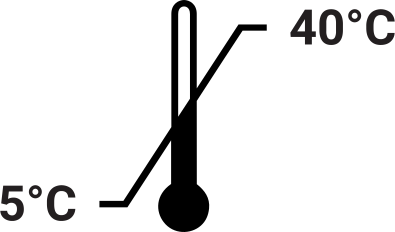
For Research Use Only. Not for Use in Diagnostic Procedures.Storage Conditions
European Pat. No. 2972400 and Japanese Pat. No. 6324485.
Resources
Articles
- Measuring Blockade of Immune Checkpoint Targets with Promega Bioassays and GloMax® Discover
- Multiplexing with NanoDLR™ and CellTiter-Fluor™ Assays
- Measuring the ADCC Reporter Bioassay Complete Kit (WIL2-S) Signal on the GloMax® Discover System
- Lumit® Cytokine Assays: Interpolating Data with the GloMax® Discover
- Comparative characterization of different molecular formats of bispecific antibodies targeting EGFR and PD-L1
- Numb-associated kinases are required for SARS-CoV-2 infection and are cellular targets for antiviral strategies
- Evaluation of cfDNA as an early detection assay for dense tissue breast cancer
- An interaction between SLC35A1 and ST3Gal4 is differentially affected by CDG-causing mutations in the SLC35A1 gene
- Simultaneous inhibition of DNA-PK and Polϴ improves integration efficiency and precision of genome editing
- Chemokine CXCL4 interactions with extracellular matrix proteoglycans mediate widespread immune cell recruitment independent of chemokine receptors.
- ACLY as a modulator of liver cell functions and its role in Metabolic Dysfunction-Associated Steatohepatitis
- Novel NanoLuc substrates enable bright two-population bioluminescence imaging in animals
- Live-Cell NanoBRET Assay for AKT Inhibitor Binding
- PD-1+TIGIT Immune Checkpoint Detection with Promega Bioassays and GloMax® Discover
- Measure JmjC Demethylase and Fe(II)/α-KG-Dependent Hydroxylase Activity with Succinate-Glo™ Assay and GloMax® Discover
- Detecting IL2 Pathway Activation with Promega Bioassays and GloMax® Discover
- Measuring Methyltransferase Activity Using MTase-Glo™ Assay and GloMax® Discover
- Measuring GTPase, GEF and GAP Activities Using the GTPase-Glo™ Assay and the GloMax® Discover System
- Using the NanoBiT® PPI System with GloMax® Discover to Detect Protein-Protein Interactions
Software and Firmware
Other Resources
Related Products
Similar Products
GloMax® Explorer System
Easy-to-use, flexible multimode detection system.
GM3500, GM3510
GloMax® Navigator System
Dedicated microplate luminometer.
GM2000, GM2010
Quantus™ Fluorometer and NGS Starter Package
Two fluorescence channels for nucleic acid and protein quantitation. Available in bundle for NGS applications.
E6150, E5150
GloMax® 20/20 Luminometer
Ultrasensitive single-tube luminometer.
E5311
Frequently Used With
QC Test Plate for GloMax® Instruments
The ideal solution for organizations that demand consistent and efficient validation of GloMax® microplate readers.
GM9000
RealTime-Glo™ MT Cell Viability Assay
A bioluminescent method to kinetically monitor viability in cell culture up to 72 hours.
G9711, G9712, G9713
Bio-Glo™ Luciferase Assay System
Bioluminescent detection reagent qualified for use with bioassays that utilize firefly luciferase.
G7940, G7941
Caspase-Glo® 3/7 Assay System
An easy-to-use, plate-based luminescent assay for detecting caspase-3/7 activity.
G8090, G8091, G8093, G8092
ViaScript® LgBiT mRNA Delivery System
Quantify endogenous protein expression in real time.
NE1120, NE1130, NE1140
NanoBiT® PPI Starter Systems
Complementation reporter for detection of protein interactions in live cells.
N2014, N2015, N2016
QuantiFluor® RNA Select System
Fluorescent system for accurate, efficient RNA quantitation.
E6640, E6780
Luminometer Injector Tubing Cleaning Kit
70% Ethanol Solution and ATP-Free Water to use with Water-Glo™ 96 Kits for GloMax® Instrument injector cleaning.
AM1110
NanoBRET® Target Engagement Selectivity DNA Controls
Quantitatively measure intracellular compound fractional occupancy against many Kinase in a single experiment.
NP1000